
Peter Ren

The AAA+ proteins (ATPases Associated with a variety of cellular Activities) are a highly diverse and ancient protein superfamily present in all organisms and are involved in such processes such as DNA replication, protein degradation, and metal insertion in protein synthesis. AAA+ proteins have some conserved features, including an oligomeric ring structure that exhibits inter-protomer cooperativitythat is to say, the hydrolysis of ATP in one subunit causes the preferential hydrolysis of ATP in the other subunits, making for a more efficient channeling of energy from ATP when switching states. While […]
Sakina Isadibir
The molecular basis of adaptation and differentiation is one of the most important, yet least understood, areas in evolutionary biology. Color polymorphic systems are a valuable, visual tool for such studies, allowing allele numbers, identities, and population frequencies to be estimated directly. In the spider family Theridiidae, discernible systems of discrete color polymorphisms have evolved independently across multiple taxa (Cotoras et al, 2017). Notably, both the Hawaiian Happy Face spider, Theridion grallator, and its fairly distant Californian relative Theridion californicum, have convergently evolved color polymorphism. For these spiders, apostatic selection […]
Zoe Lung

Meiosis is an essential cell division process that involves the reduction of chromosome number, thus creating haploid cells from diploid cells. Since mistakes in this process can lead to aneuploidy and many genetic defects such as cancer, this division is highly regulated and consists of many regulatory checkpoints. One such checkpoint, referred to as the synaptic checkpoint, is necessary during the early stages of meiosis when chromosomes are paired with homologous partners prior to segregation. The specific mechanisms that are involved in regulating this particular checkpoint still remain unknown. Recently, […]
Noah Stevenson
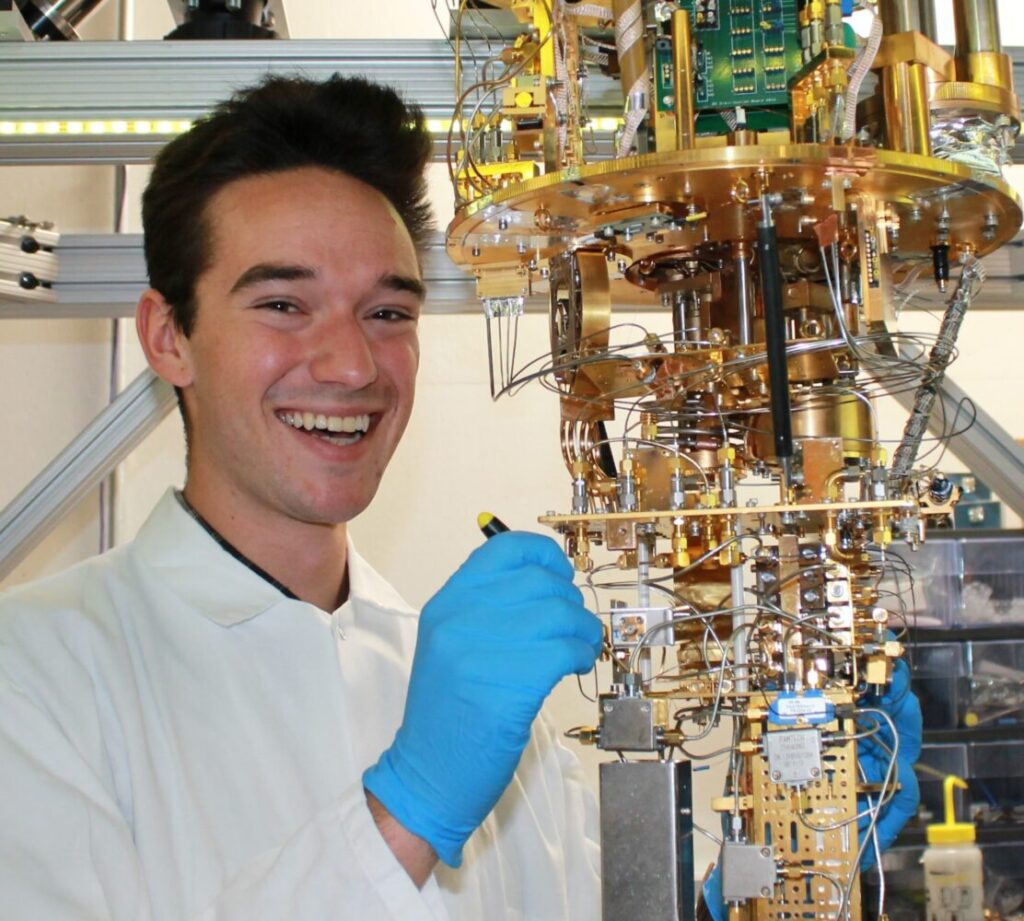
Theoretical and experimental evidence suggests harnessing quantum mechanics to execute algorithms on qubit-based quantum hardware may allow for computation exponentially more powerful than is possible with classical computers. Characterizing how qubit states evolve in time is imperative for benchmarking quantum hardware; however, this has been difficult due to the inability to fully measure a quantum state without disrupting it. A solution is weak measurement, which recent work has improved for a single qubit by leveraging the data-processing power of a recurrent neural network (RNN). The time-evolution of qubits exchanging information […]
Mingyu Li
Neutrino-less double beta decay is a process that is forbidden in the current Standard Model of particle physics since it violates lepton number conservation. If observed, this type of decay can provide insight into fundamental neutrino properties, such as whether neutrinos are Majorana or Dirac fermions (i.e. whether they are their own anti-particles). This decay also provides information on the neutrino mass hierarchy and its mass scale. Cryogenic Underground Observatory for Rare Events (CUORE) is a leading experiment in this search and its successor, CUORE Upgrade with Particle ID (CUPID) […]
Jenny Lai

Despite the ever increasing number of identified genetic diseases, many of the genes associated with these human disorders are still either poorly understood or have not yet been functionally described during development. My work will pursue the characterization of three genes: scinderin (scin), angiotensin-I-converting-enzyme (ace), and clustered mitochondria cluA homolog (cluh), which are all expressed in the kidney according to preliminary findings in the Harland lab. Using Xenopus as a model, I will study the role of these three genes in nephrogenesis and kidney function through a series of experiments […]
Yiyang Jin
In this project, I want to find out if chromodomain helicase DNA bind protein 8 (CHD8) and other CHD family proteins, which are known chromatin regulators, will interact with the RNA polymerase II elongation factor ELL2. ELL2 is an important component of the Super Elongation Complex (SEC). SEC plays a very crucial role in HIV transcription and reactivation of HIV virus from latency. On the other hand, CHD8 is a member of the chromodomain helicase DNA-binding family, which consists of 9 protein homologs that are all chromatin remodeling factors. Chromatin […]
Jasmine Larrick

A hallmark of severe dengue virus (DENV) infection is vascular leak. DENV non-structural protein 1 (NS1) directly triggers endothelial hyperpermeability and vascular leak via disruption of the endothelial glycocalyx layer (EGL). The EGL is a matrix of glycoproteins and membrane-bound proteoglycans lining the vascular endothelium, playing a protective role in maintaining endothelial barrier integrity. DENV NS1 binds to the endothelial cell surface through interactions with surface glycosaminoglycans (GAGs), such as heparan sulfate or chondroitin sulfate. However, the specific amino acid residues responsible for conferring cell binding specificity of various flavivirus […]
Konnor von Emster

The upside-down jellyfish, Cassiopea, is a model organism for sleep despite its decentralized nervous system (DNS). The nervous system consists of radially spaced, interconnected motor control nerve clusters, ganglia, that control Cassipeas pulsing behavior. Preliminary research indicates that a unique subset of these ganglia may command pulsing for days to weeks at a time instead of random command that current literature suggests. My research will be focused around answering the question: what molecular differences cause morphologically identical ganglia to have activity differences? RFamide and Taurine are neuromodulators known to exist […]
Nicole Mizrahi
The Cretaceous-Paleogene (K-Pg) mass extinction (~66 million years ago) is hypothesized to have been caused by environmental effects of the Chicxulub asteroid impact and/or Deccan Traps flood volcanism in India. Both potentially caused major climatic change through increased sulfate aerosol production, which would have caused significant global cooling and/or acid rain. Sulfur released by each of these events has a distinguishable isotopic composition. To characterize changes to the sulfur cycle across the K-Pg boundary and investigate the role each catastrophic event played in the extinction, I will measure sulfur abundance […]