
Stephanie Tjho
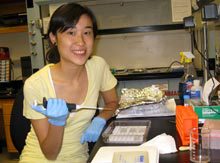
Circadian rhythms, generated in the suprachiasmatic nucleus (SCN) in the brain, are found in a wide range of organisms, and play an important role in the generation and maintenance of many biological processes. Chronic disruption of the circadian rhythm, as seen in flight attendants and other shift workers, has been found to be correlated with increased cancer rates. My project will examine the impact of jetlag on immune function, and use cell sorting methods to examine whether there is a change in the amount produced or time of production of […]
Julia Elizabeth Himes
The blue ringed octopus (H. lunulata) is a highly toxic animal, secreting tetrodotoxin (TTX) as a means of defense and prey capture. H. lunulata is an important organism for studying toxicity and its role in behavior, evolution, and reef ecology. Today, these octopuses are taken from the wild for study, and few survive in captivity. The goal of this summer’s project is to design a method of rearing H. lunulata from egg to maturity. This is very difficult, as the paralarval hatchlings or this species are pelagic and require a […]
Chung Yan Cheung
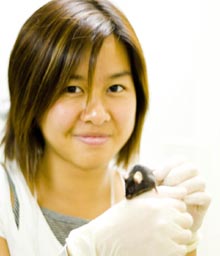
Development of the nervous system depends on the migration, differentiation, and axonal projections of neurons to their appropriate targets. In the dorsal spinal cord where many sensory and interneurons are born, signaling cues specify the development of neuronal precursors into an array of cell types. However, the process by which these signals regulate neuronal growth is still unclear. This summer, I will examine the function of the Gremlin2 gene, which is expressed in a specific population of dorsal interneurons. Taking advantage of Gremlin2 knock-out mice, I will use immunocytochemistry to […]
Seita Onishi
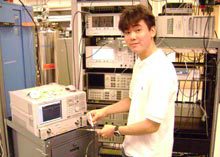
My project is to design, test and construct an electronic amplifier customized for data-taking in low temperature experiments (liquid helium cooled) at the Quantum Nanoelectronics Laboratory. Electrical signals from experiment samples are too weak to be measured directly, so this amplifier will make the signals stronger. For the transistor, the essential part of the amplifier, I will use a commercial Silicon-Germanium transistor, which is known for its low cost. Using computer simulations and testing of the amplifier characteristics, amplifiers for various experiments in the lab demanding different frequency ranges can […]
Yohan Song
I am analyzing the vascular organization of the cat inferior colliculus (IC), a major auditory structure in the midtbrain, to determine whether its divisions share a common pattern. The IC consists of the central nucleus (CN), the dorsal cortex (DC), and the lateral cortex (LC), each with different roles in auditory behavior and perception. I am comparing the IC capillary distribution to quantify differences between subdivisions using plastic-embedded material from two adult cats in 1 m-thick semithin sections stained with toluidine blue. Ten non-overlapping random 200 x 200 m2 samples […]
Toral Trivedi
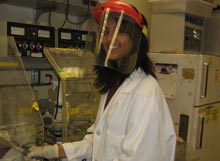
It has been discovered that Curly, the early developmental mutation in Xenopus tropicalis, a frog model for human biology, leads to an abnormal number of Mitotic cells during the cell cycle. The mutant phenotype is possibly due to the abnormal expression of cell cycle factors. Mapping the location allows us to study these factors, creating a greater understanding of cancer. My project focuses on using primers to map the Curly mutation by using a combination of two methods. One involves natural mating between hybrid Curly carriers, and the other generates […]
Lisa Wong
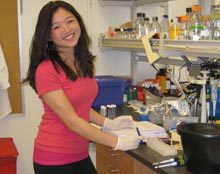
This summer, the aim of my project is to investigate the origin of drug resistance in hospital acquired, multi-drug resistant bacteria. This project challenges the idea that human overuse of antibiotics is dominant in selecting for drug resistance in bacteria, and instead investigates the role of food as the primary source of new drug resistance for bacteria in our body. This is a particularly dangerous and has wide public health implications because of the ability for pathogenic bacteria in hospitals to rapidly acquire new drug resistances. Bacteria can harbor drug […]
Scott Michael Coyle
Changes in cellular programming are often thought to be mediated by changes in regulation at the level of transcription. However, there is increasing evidence that changes in the regulation of translation may play an equally important role in the reprogramming process. In our lab, we have found that the transition from a vegetative to invasive physiology in the yeast S. cerevisiae requires a novel mode of regulation of translation. I recently identified a protein, Asc1, which is required for this transition and potentially acts directly at the level of translation. […]
Andrea Chiem
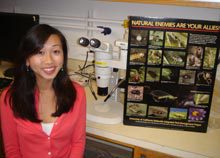
Studies have shown that cabbage aphids (Brevicoryne brassicae) that eat black mustard (Brassica nigra) can sequester toxic compounds to ward off their predators. This summer, I am building on these studies by examining the eco-physiological costs to aphids of processing and sequestering these toxins. The concentrations of the toxins will be analyzed to determine the difference in chemical load for aphids that eat broccoli (Brassica oleracea) versus mustard. My main goal is to study the physiological costs of this chemical load by examining differences in development and reproduction of aphids […]
Janet Luo

The importance of studying genetic variants in humans has given rise to the worldwide HapMap Project, which can potentially lead to techniques to diagnose, treat, or prevent illnesses according to each persons different genetic makeup, thus enhancing efficacy. This project tests a method to identify crossover breakpoint regions at a higher resolution than previous studies have. Because single nucleotide polymorphisms are bi-allele, their limited number of states can be analyzed case by case in advance; studying families of three generations using tri-trio pedigree charts allows for the deduction of information […]