
Sarah Cohen

Climate change, whether one believes in it or not, is an undeniably large presence in discourses about environmentalism, policy, and morality. Though the consensus among scientists about the reality and anthropogenic origin of global warming is solid, the general public is much less convinced. I am therefore interested in examining how an individuals understanding of the mechanism of the greenhouse effect is related to their political attitudes about climate change. To study this association, I will be running a survey project in “America’s Finest City,” San Diego. Once the data […]
Meriel Melendrez
Coast Redwoods can grow over three hundred and fifty feet tall—well overtopping Sather Tower’s three hundred and seven. An individual Redwood might live in multiple above-ground micro-climates that can be especially noticeable on a sunny day: from low, perhaps shady to dry, hot, dizzyingly high-up. Macro-morphological features of their leaves (e.g. surface area and connection to the stem) have been demonstrated to correlate with such great height, suggesting that variable leaf structures work together with towering stature. What the stomata, pores, are up to meanwhile has yet to be as […]
Jared Rosen
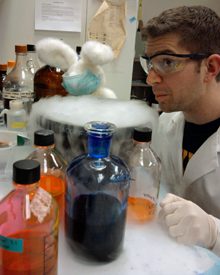
The H, K ATPase is a P-type ATPase proton pump that is highly expressed in the gastric parietal cell. This enzymatic proton pump is responsible for creating the highly acidic environment in the lumen of the stomach. The protein is comprised of a larger catalytic “alpha” subunit that creates the high proton gradient and a smaller “beta” subunit. The goal of my research project is to gain a deeper insight into how it is that the H,K ATPase protects itself from digestion by the very acid that it produces to […]
Benjamin Karin

I am studying song variation and population subdivision in two named subspecies of Sage Sparrow (Amphispiza belli) in California. California Coast Range populations (A. b. belli) are physically much darker in color and have more contrasting patterns than Central Valley and Mojave Desert populations (A. b. canescens). Though all the A. b. canescens populations look exactly the same, previous genetic studies have shown Central Valley A. b. canescens populations to be closer genetically to Coast Range A. b. belli than to the Mojave Desert population of A. b. canescens (Cicero […]
Vivek Musinipally
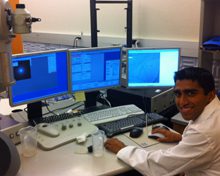
Cancer is the second leading cause of death in the United States . It has long been known that improper cell division often leads to proliferation of tumors eventually resulting in cancer. Thus, studying the proteins involved in cell division is important to the process of eventually preventing and curing the malignancy. My project involves the characterization of a protein, CENP-F (mitosin), associated in the outer kinetochore of cells that is known to bind microtubules, an essential component that drives cell division. I aim to characterize the microtubule binding activity […]
Timothy Roth
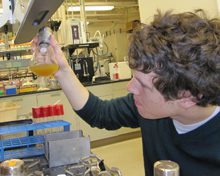
The current energy crisis in the US has demanded the production of alternative, renewable fuels to replace our current petroleum-based fuels. However, the limitations of the current biofuel standard, ethanol, require the development of second-generation fuels that can be used with existing engines and infrastructure. One such fuel is n-butanol, which the M. Chang group has successfully produced at good yield using a synthetic metabolic pathway engineered into E. coli. The Dueber Lab has demonstrated that synthetic protein scaffolds can be used to colocalize enzymes in metabolic pathways in varying […]
John Campo
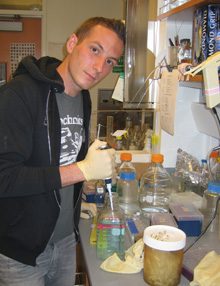
The ultimate goal of my research is to identify the structure of the subunit of DNA polymerase III in Aquifex aeolicus (Aquifex) using X-ray crystallography. DNA pol III is the enzyme that is responsible for the majority of the DNA replication that occurs in this strain of bacteria. The the subunit of DNA pol III is responsible for the polymerase activity. To date, the structure of the replicative unit has only been determined in two gram-negative bacteria, Escherichia coli (E. coli) and Thermus aquaticus (Taq) (Lamers et al., 2006, and […]
Sivapratha Nagappan Chettiar
Neurogenesis, the production of new neurons, occurs via the asymmetrical division of neural stem cells in specific regions of the mammalian and Drosophila brain. It is a highly regulated process as proper neuron type and number is crucial to allow the proper formation and functioning of the brain. In Drosophila brain, much is known about the pathways that regulate asymmetric cell division. However, little is known about the mechanisms that regulate its termination. In PTEN tumor suppressor gene mutants, neural stem cells aberrantly persist in the brain of adult Drosophila. […]
Elina Serrano
KCNK18 is a two-pore potassium channel that is hypothesized to play a key role in pain and touch. Mutations in the KCNK18 gene have been found in people suffering from familiar migraine. Furthermore, this channel is targeted by a variety of anesthetics as well as hydroxy–sanshool, the active ingredient in Szechuan peppercorn responsible for its tingling and numbing analgesic properties. Since the parts of the protein responsible for function and modulation of the channel have not been identified, the specific goal of my project is to create and screen a […]
Xinkang Wang
This project aims at providing constraints on the dark energy parameters through galaxy surveys. In theory, given the precise values of cosmological parameters, including the dark energy parameters (e.g., the density parameter ), we are able to determine the history and the ultimate fate of the universe.Therefore, to better understand the evolution of the universe and to improve current related theories in physics, we need to determine the values of dark energy parameters with higher precision to put in another way, we need to put further constraints on the parameters. […]