
Io Kleiser

Several newly discovered supernovae, or stellar explosions, are unusually faint and fast-evolving and defy our usual classification schemes. Their light curves (brightness over time) in particular show how quickly they rise to maximum brightness and then decline. They are also unlike any previously known supernovaeand unlike each otherin their electromagnetic spectra. Several attempts have been made to identify the properties of these supernovae and their progenitor stars based on their spectra and light curves, such as the energy of the explosion, the amount of mass ejected, and the elemental composition; […]
Alex Yang Lu
My research this summer focuses on battling Glioblastoma Multiforme (GBM), the most common and malignant type of brain tumor. Despite invasive surgical resection and pharmaceutical therapy, patients with GBM have a mean survival time of 12-15 months following diagnosis, making GBM among the most aggressive of human cancers. Tumors growth is dependent upon vascularization through the formation of new capillaries from pre-existing blood vessels, a process called angiogenesis. Numerous cytokines and growth factors have been shown to regulate angiogenesis while modulating cell invasion, growth and differentiation; however, these mechanisms remain […]
Nicole Wong Meng Lai
My research project involves investigating a cytoskeletal protein named WHAMM- WASP homolog associated with actin, membranes, and microtubules. The cytoskeleton is a crucial component of the cell that facilitates protein transportation, structural support, and ultimately the movement and division of cells. It does so through actin polymerization, which is the formation of filaments using actin molecules. An important stimulator of actin polymerization is the Arp 2/3 complex. It is regulated by nucleation-promoting factors, one such example being WHAMM. My project focuses primarily on the WMD domain of WHAMM, which is […]
Alyssa Tao
The immune system is the bodys way of responding to invading disease-causing microbes and mutation-induced tumor cells, which have the potential to become cancer. Thus, the immune response protects against both infectious disease and cancer, and its regulation and activation are extremely important for maintaining health. T-cells play a central role in the immune response both in recognition and in downstream pathways that lead to microbe or tumor destruction. A protein that is essential in the signaling cascade of the T-cell is ZAP-70 (Zeta-chain-associated protein kinase 70). I will be […]
Adam Krause

Recent evidence suggests that sleep and sleep loss have profound effects on emotional brain reactivity, especially for positive emotional experiences. As a consequence, sleep disruption may lead to detrimental risk taking and reward seeking. However, it remains unclear exactly what type of sleep helps reset the brains ability to appropriately react to rewarding experiences. I propose to test the hypothesis that a specific type of sleeprapid-eye movement (REM) sleep, and its associated electrical brain activityrestores the optimal next-day reactivity to rewarding, motivating experiences. I will therefore investigate whether the quantity […]
Eric Lu
Many eye diseases, such as diabetic retinopathy, age-related macular degeneration, and macular edema, are caused by the abnormal development of retinal vasculature. My project aims to better understand the signaling network that regulates this process by examining the function of two key molecules: Very LowDensity Lipoprotein Receptor (VLDLR) and Low Density Lipoprotein Related Protein 5 (LRP5). Previous studies have demonstrated that VLDLR promotes vessel growth while LRP5 inhibits it. Additional studies done by the Gong lab suggest that LRP5 plays a more dominant role in this process. In order to […]
Alina Boltunova
Emmetropization is a normal developmental process in which the eyes growth is regulated to achieve a match between eye length and its refractive power. It results in the reduction of refractive errors present at birth and has been observed in all animal species, including humans, studied thus far. The guinea pig is increasingly used to model myopia (near-sightedness), but there appear to be differences between guinea pig strains in their susceptibility to myopia-inducing stimuli. To understand the origin of these differences, I plan to compare the emmetropization of different strains […]
Angela DiRocco

Arboreal animals such as the Green Anole, Anolis carolinensis, must be able to manipulate aerial descent to reduce injury when dislodged from elevated habitats. To maintain controlled aerial descent, the anole must obtain a prone posture. Anoles have been known to correct orientation after dislodgement by use of their tails through either the conservation of momentum to induce roll or by lateral swings which alter yaw. While the mechanics behind yaw and roll alterations are understood, the extent to which an anole can correct pitch at high angles is not. […]
Mark Phuong
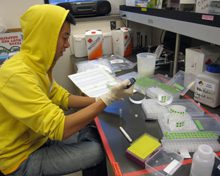
Species Distribution Models (SDMs) provide one of the only methods for projecting the future distribution of species and are increasingly used to prioritize conservation efforts. SDMs correlate species’ occurrence points with climatic variables (e.g., temperature and precipitation) to produce a distributional map of the climatic limits of a species. Genetic studies of geographic variation within species, or phylogeography, often uncover cryptic lineages that have remained evolutionarily isolated for thousands to millions of years. My research assesses how identifying cryptic diversity within species affects the predictions of SDMs. Faced with climate […]
Ben Reuveni

Human memory is characterized by multiple memory systems. Two of the most widely recognized of these are the procedural and declarative systems. My project extends a line of research aimed at exploring the interaction between these systems. Previous research using category learning paradigms widely thought to selectively tap either the procedural or declarative memory system has implied that these two systems compete for control of motor resources.For example, human participants usually perform poorly in category learning tasks in which optimal performance requires trial-by-trial switching between procedural and declarative strategies. My […]